Basque Burnt Cheesecake (Tarta de Queso)
The cheesecake with a deliberately scorched top and a custardy, spoonable centre. Five base ingredients, one bowl, no water bath and no crust.
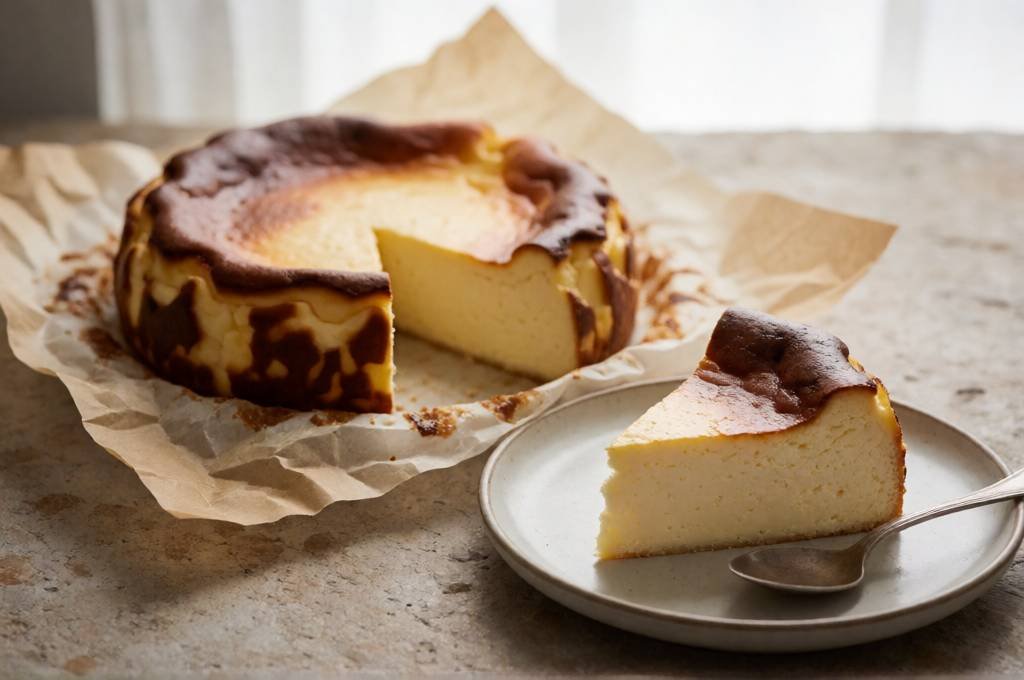
The method is deliberately loose. You beat cream cheese with sugar, add eggs and cream, and bake it hot so the outside caramelises before the middle finishes setting. Resist the urge to bake it until it looks done — a wobble in the centre is exactly right, and it firms up as it cools. It is at its best a few hours after baking, once it has settled.
Ingredients
- 800 g full-fat cream cheese, at room temperature
- 200 g caster sugar
- 4 large eggs, at room temperature
- 300 ml double cream (heavy cream)
- 2 tablespoons plain flour
- 1 teaspoon vanilla extract
- 1/4 teaspoon fine sea salt
- Butter, for the tin
Instructions
- Heat the oven to 230°C (450°F). Line a 20 cm springform tin with a large sheet of baking paper, crumpled and pressed in so it sits in uneven folds and stands a few centimetres above the rim. Butter the paper lightly.
- Beat the cream cheese and sugar in a large bowl with a whisk or on low speed until completely smooth and lump-free. Scrape the sides of the bowl down as you go.
- Add the eggs one at a time, mixing just until each disappears. Keep the mixing gentle from here — too much air makes the cheesecake puff and then crack as it cools.
- Stir in the cream, vanilla and salt, then sift over the flour and whisk until the batter is glossy and pourable.
- Pour the batter into the lined tin. Tap the tin twice on the counter to release any large bubbles.
- Bake for 30-35 minutes. The top should be deep amber to nearly black in patches and puffed at the edges, while the centre still wobbles noticeably when you shake the tin.
- Cool in the tin on a rack to room temperature — the centre will sink and settle. Then refrigerate for at least 4 hours, or overnight, before serving.
- Serve in generous wedges, straight from the tin or lifted out by the paper, at room temperature or lightly chilled.
Cook’s tips
- Everything at room temperature. Cold cream cheese lumps and cold eggs make a grainy batter.
- If your oven runs hot, bake at 220°C (425°F) and give it 5 extra minutes — you want a dark top without a bitter, blackened centre.
- Pull it out while the middle still wobbles. Carry-over heat finishes the custard as it cools.
- For clean slices, wipe the knife between cuts with hot water.
Substitutions
- The plain flour can be left out entirely for a softer-set, flourless version; the centre will be looser.
- A darker muscovado sugar in place of some caster sugar deepens the caramel notes.
- Serve with roasted berries, a spoonful of crème fraîche or a drizzle of honey instead of a sauce.
Storage & reheating
Cover the cooled cheesecake and refrigerate for up to 4 days; it gets denser and richer each day. It also freezes well — wrap individual wedges tightly and freeze for up to 2 months, then thaw overnight in the fridge.
FAQ
Is the top supposed to be burnt?
Yes. The dark, blistered surface is the signature of a Basque cheesecake and gives it a toasty, caramelised flavour. It should taste bitter-sweet, not ashy.
Why does my Basque cheesecake crack?
Usually too much air beaten into the batter or an oven that is too hot. Mix gently once the eggs go in, and keep the centre underbaked.
Can I make it without a springform tin?
Yes — use a lined cake tin or a shallow baking dish. Because there is no crust, you can also serve it straight from the dish with a spoon.
How long does it need to chill?
At least 4 hours, ideally overnight. Straight from the oven it is too soft to slice neatly.